Arc OMS — Salla-Integrated Digital Order & Fulfillment System
An order operations system that helps digital product retailers receive, route, fulfill, and track orders while coordinating teams and customer communication through one unified operational workspace.
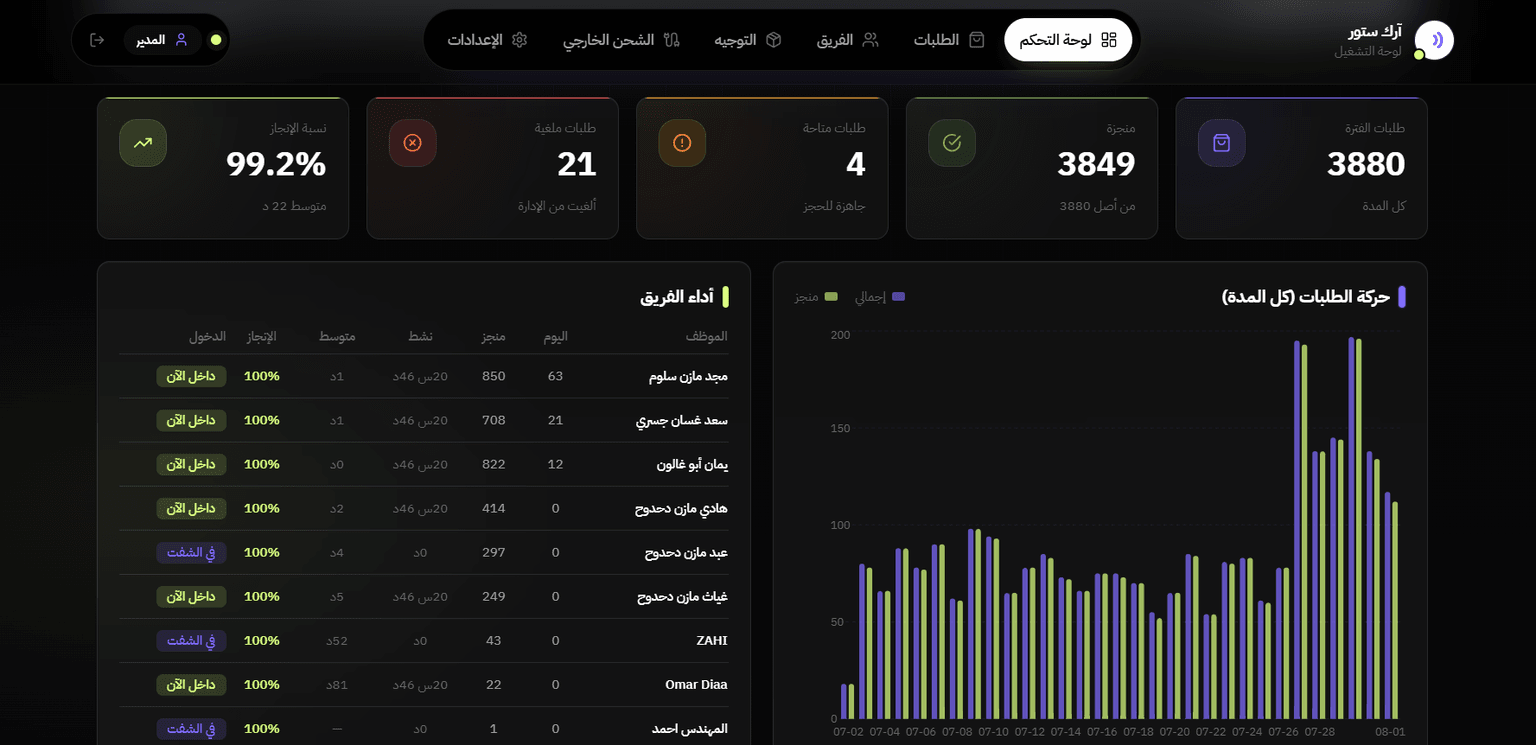
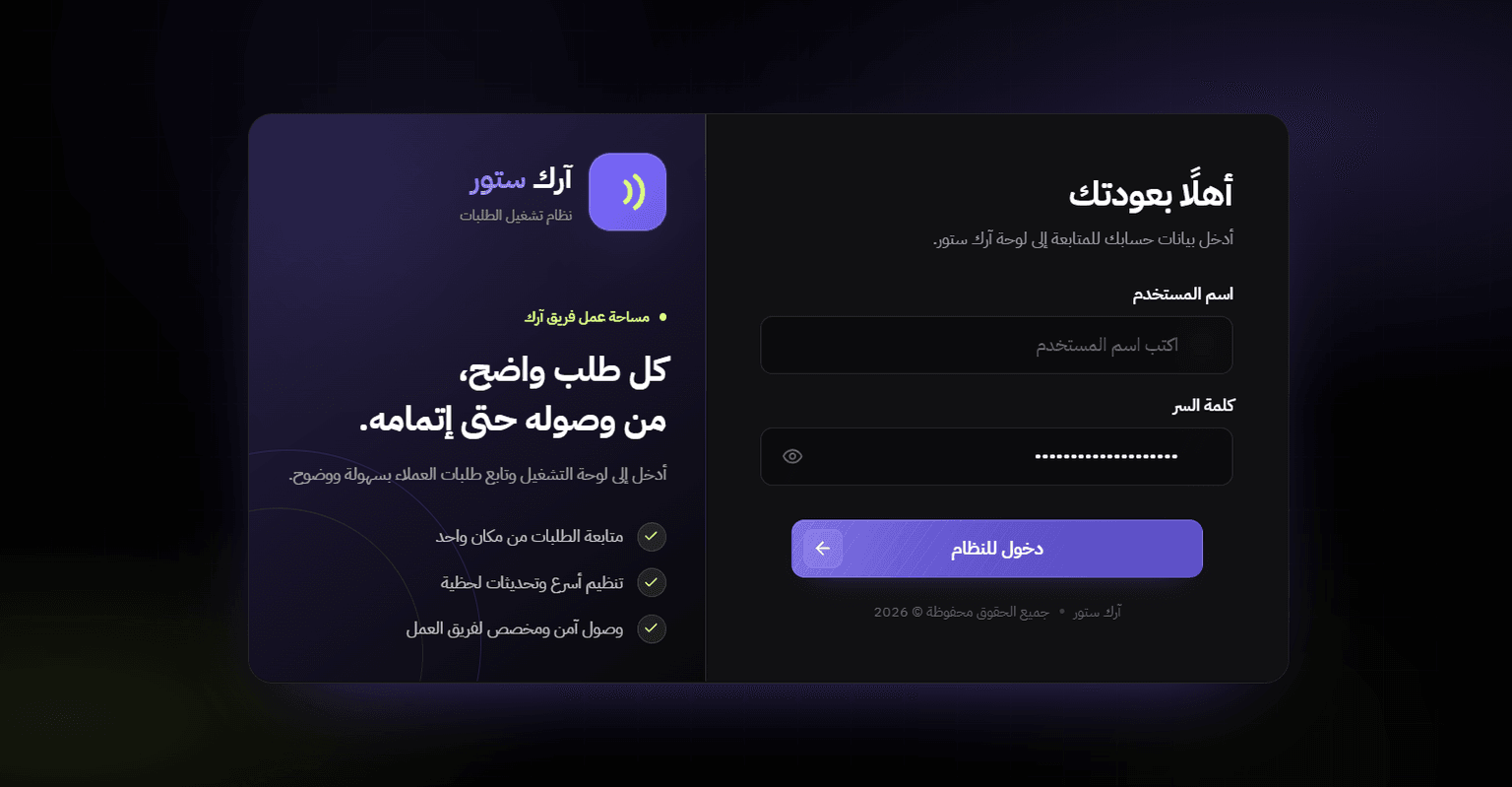
Swipe or select a preview
Overview
Arc OMS was built to close the operational gap created when digital-product orders are spread across the storefront, fulfillment staff, customer conversations, order statuses, code inventory, and external fulfillment providers. Customers continue purchasing through the existing Salla storefront, while Arc OMS manages fulfillment, status follow-up, and WhatsApp communication behind the scenes. Conversations are linked directly to their orders, giving the service team the context needed without searching across disconnected channels. Internally, the platform brings open orders, product-based routing, claiming and assignment, status updates, Salla synchronization, WhatsApp conversations, code inventory, and external fulfillment into one operational workspace. Employees receive a focused workspace containing the orders they are eligible to handle, with tools to claim, process, complete, and discuss each order with the customer. Administrators receive broader oversight across open orders, assignments, team activity, schedules, status history, reassignment, cancellation, and cases requiring synchronization or fulfillment intervention. Arc OMS simplifies work that would otherwise require manual coordination, including receiving and distributing orders, notifying the appropriate team, connecting customer messages with order context, synchronizing Salla statuses, allocating fulfillment codes, and processing supported products through Midas and Sawa Play. Controlled manual handoff remains available when automatic fulfillment cannot safely finish a request. The product goes beyond a basic order dashboard. It enforces role-based visibility, prevents concurrent ownership of the same order, persists external operations for safe recovery, protects against duplicate execution and repeated code consumption, and records order transitions for operational review.
About the Project
An order operations system that helps digital product retailers receive, route, fulfill, and track orders while coordinating teams and customer communication through one unified operational workspace.
Tech Stack
Challenges
1. Unifying a fragmented order lifecycle Problem: The order lifecycle depended on storefront data, employee actions, customer messages, digital inventory, and external providers. Business impact: Context could be lost and follow-up delayed when teams moved between disconnected tools. Solution: Arc OMS organized these activities around one order record containing its owner, current status, conversation, event history, and fulfillment path. 2. Preventing conflicting order claims Problem: Multiple employees could attempt to claim the same order at the same time. Business impact: This could cause duplicate fulfillment or conflicting customer communication. Solution: Database-level locking and centralized visibility policies ensure that an order has only one owner, including when records are accessed directly through the API. 3. Routing each product to the correct workflow Problem: Products do not share one fulfillment path; some require employees, some are excluded, and others belong to a specific provider or operator. Business impact: Incorrect routing delays fulfillment and may expose orders to the wrong employee. Solution: Centralized SKU, prefix, employee, and notification-group rules determine the eligible destination and fail safely when routing rules conflict. 4. Keeping external services consistent with internal order state Problem: Salla or a fulfillment provider may complete an action while the confirmation response is interrupted. Business impact: Blind retries could repeat a status update or customer fulfillment. Solution: Stable action identifiers, durable jobs, reviewable states, bounded retry cycles, and administrator-controlled recovery protect external operations from accidental duplication. 5. Preserving customer context across WhatsApp conversations Problem: Customer messages stored separately from orders make it difficult to identify the relevant purchase, employee, and current status. Business impact: Staff spend more time searching and customers may receive inconsistent answers. Solution: WhatsApp conversations are linked to orders with support for text, images, audio, quick replies, and real-time conversation updates. 6. Protecting digital-code inventory Problem: Fulfillment codes are sensitive financial assets that can be exposed or consumed more than once under concurrent activity. Business impact: Duplicate consumption can create direct losses and weak accountability. Solution: Codes are encrypted, masked by default, protected by reauthentication, and allocated through transactional rules that prevent repeated reservation or use. 7. Handling uncertainty in browser-based provider fulfillment Problem: A provider session may stop or return an unclear result after fulfillment has started. Business impact: Repeating an uncertain transaction could fulfill the same customer twice. Solution: Preparation and execution are separated, commitment is recorded before the final provider action, evidence is retained, and ambiguous outcomes are sent to controlled review instead of being retried blindly.
Results & Impact
- Unified order intake, employee routing, Salla statuses, WhatsApp conversations, code inventory, and external fulfillment within one operational workflow. - As of August 1, 2026, the database contained 3,880 orders, including 3,848 completed orders and 2,754 orders received during the previous 30 days. - Supports 9 active employees through role-specific workspaces, with 4,620 recorded status events providing clearer ownership and order-history visibility. - Organized 10,139 WhatsApp messages across 2,757 order-linked conversations, keeping customer communication and order context together. - Processed 209 external-fulfillment requests: 174 completed automatically, 30 completed through controlled manual handling